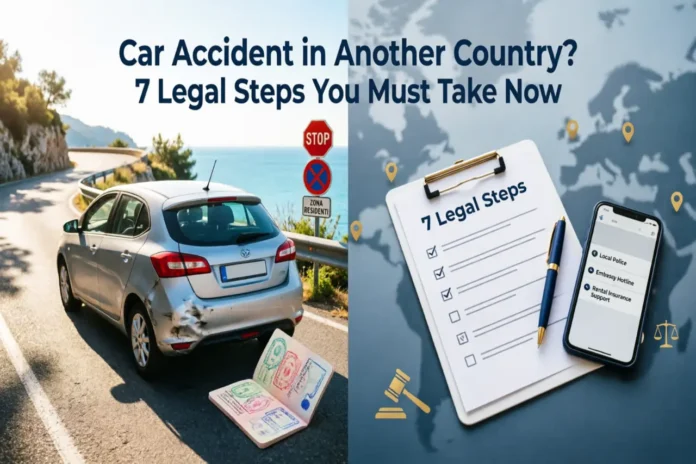
You’re driving on vacation or a business trip. Suddenly, a local driver runs a stop sign and slams into your rental car. Back home, you’d call the police, swap insurance, and be done. But in another country? That same accident can land you in a foreign jail, cost you thousands in cash, or freeze your passport.
Why? Because laws, insurance rules, and legal procedures differ wildly. What’s a minor fender-bender in the U.S. or UK might be a criminal offense in Germany, Japan, or Turkey. And many travelers don’t realize: your personal auto insurance usually stops at the border.
This guide walks you through the exact legal steps after a car accident abroad — from the first five minutes to dealing with courts and leaving the country. No fluff, just practical law.
First 24 Hours: Legal Steps at the Scene
Ensure Safety Without Admitting Fault
Your first job: get to safety. But be careful what you say. In many civil law countries (France, Italy, Argentina), saying “I’m sorry” or “my fault” can be used as a legal admission of liability. Stick to factual statements: “The other vehicle hit my left door.” Do not sign anything you don’t fully understand.
Who to Call First (It’s Not Your Home Insurance)
Call local police — not your embassy. Dial the local emergency number (112 in Europe, 911 in many Americas, 110 in Japan/China). Tell them there are foreign nationals involved. Ask for an English-speaking officer if possible.
Do NOT rely on the other driver to call. In some countries (Mexico, India, Vietnam), drivers may try to avoid police involvement to hide a lack of insurance or a license. You call.
What to Document Before Anyone Leaves
Take photos and video: all vehicle damage, license plates, road conditions, signs, and the other driver’s face. Write down the exact time and GPS coordinates. Get witness names and phone numbers — locals may be more believable than you in court.
Most important: get the police officer’s name, badge number, and station location. Without that, you cannot request the police report later.
Understanding Local Laws That Can Trap You
Countries Where You Cannot Leave the Scene – Even for Minor Crashes
In Germany, Austria, and Switzerland, leaving the scene of any accident — even a scratched parked car — is fahrerflucht (hit-and-run). Penalties: fines up to €30,000, driver’s license suspension in the EU, and possible jail time. You must wait for the police, even for minor damage.
In Japan, leaving without exchanging information formally is a criminal offense under the Road Traffic Act. Tourists have been detained for days over small parking-lot bumps.
Mandatory Reporting Timelines That Vary by Country
Most European countries require reporting within 24 hours. Turkey: 5 days. United Arab Emirates: you cannot move the car before police arrive — doing so voids your insurance. In some U.S. states (for non-residents), you might have 10 days. But as a foreigner, the shorter timeline almost always applies to you. Report immediately.
Alcohol and Drug Testing Rules Abroad
In France, random breathalyzer tests are common. Refusing equals a fine equivalent to drunk driving. In Sweden, any alcohol over 0.02% BAC is a crime, stricter than most countries. Some nations (Russia, Poland) can test you at the hospital without consent. If you’ve had even one drink, you may be legally impaired in that country. Know the local limit before you drive.
Insurance: What Covers You and What Absolutely Does Not
Rental Car Insurance vs. Your Own Policy
Most U.S. and Canadian auto policies exclude foreign countries (except Canada). Some cover you in Canada and Mexico but nowhere else. European policies often cover other EU countries, but not Turkey, Morocco, or Egypt.
Rental car insurance (CDW/LDW) usually covers the car itself — not third-party liability, not medical, not legal defense. Read the fine print. In many countries, the rental contract makes you personally liable for all damages until the case is resolved.
The Critical Role of the “Green Card” or Local Proof
If you drive your own car across EU borders, you need an International Insurance Certificate (Green Card). Without it, the police can impound your car. In non-EU countries (Serbia, Bosnia, and Ukraine), you must buy local insurance at the border. One accident without it can mean arrest.
When You May Have to Pay Out of Pocket First
Here’s a shock: in many countries, police won’t release your passport or rental car until you pay a “deposit” for estimated damages — even if you weren’t at fault. In Greece, Italy, and Portugal, you may pay €500–€2000 cash on the spot. In Thailand, without insurance, you pay hospital bills first, then fight in court later. Keep emergency funds separate from your vacation budget.
Step-by-Step: Reporting the Accident to Local Authorities
- Get a copy of the police report — in the local language. Ask for a certified translation or find an interpreter later. Without this report, your insurance won’t pay.
- Request a “foreigner-friendly” case number — some countries (e.g., Spain, Costa Rica) have special units for tourist accidents.
- Do not pay a fine at the scene unless required by law — in some places, officers who demand cash directly are scammers. Legitimate fines are paid at a police station or courthouse.
- Contact your consulate — they cannot get you out of jail, but they can provide a list of local lawyers who speak your language and confirm you are being treated fairly.
Your Legal Rights as a Foreign Driver
Right to an Interpreter and Consular Assistance
Under the Vienna Convention on Consular Relations (ratified by most countries), you have the right to contact your embassy or consulate after an arrest or detention. Police must inform you of this right. If they don’t, anything you say may be challenged. But in practice, many local officers “forget.” Remind them politely: “I request my consulate.”
Can You Leave the Country Before the Case Closes?
Usually not. If the accident causes injury or death, or if you are suspected of a crime (DUI, hit-and-run), the local court can seize your passport. In France and Italy, even minor injury cases can take months — you may be required to post a bond (often €2,000–€10,000) to leave. Never assume you can fly home and forget about it.
Common Mistakes That Lead to Fines, Arrest, or Lawsuits
- Signing a document you don’t understand — local drivers sometimes carry pre-written “mutual agreement” forms in their language. You might be signing away your right to sue or admitting full fault.
- Thinking your credit card insurance covers liability — most card benefits cover damage to the rental car only. Medical bills for others? Not covered.
- Leaving without a police report — your insurance will deny the claim. You’ll personally owe thousands.
- Posting on social media — in defamation-friendly countries (U.K., South Korea), saying the other driver was “drunk” without proof can get you sued.
Real-World Legal Scenarios
Scenario 1 – Hit a Pedestrian in Spain
You’re driving in Barcelona. A pedestrian steps off the curb without looking and hits your passenger’s mirror. Police arrive. Under Spanish law, drivers are presumed liable for pedestrian injuries unless they prove negligence. Your rental insurance liability is a minimum of €70 million (Spanish law). But your personal policy from home covers nothing. A local lawyer costs €150–€300/hour. Settlement negotiations take 4–8 months. You cannot leave Spain without a court order.
Scenario 2 – Minor Bumper Damage in Thailand, Jailed for No Insurance
You rent a scooter in Phuket. You tap a parked car — barely a scratch. The owner demands 50,000 baht ($1,400). You refuse. Police are called. You have no Thai insurance, no international license. Under Thai law, you are driving illegally. The judge orders you jailed for 5 days until a relative wires bail. Legal fees: $2,000. Total loss: $5,000 for a scratch.
Costs You Might Face (Lawyer, Police Reports, Court Fees)
- Police report – Free to $200 (some countries charge foreigners more).
- Certified translation – $50–$300 per document.
- Local lawyer (English-speaking) – $100–$500/hour. In Western Europe, $250–$600/hour.
- Court filing fees – $50 to $1,500.
- Bail or bond to leave the country – $1,000–$15,000, depending on injuries.
- Uninsured liability judgment – $10,000 to $1 million. Yes, a million.
Most foreign accident cases settle for $3,000–$25,000 out of pocket if you lack proper insurance. That’s why travel insurance with high liability coverage ($1M+) is non-negotiable.
Conclusion – Your Next Steps After Returning Home
If you’ve had a car accident abroad, don’t panic — but act fast. First, confirm that you legally closed the case in that country. Second, request a translated police report for your insurance. Third, contact your home insurer and rental company in writing within 7 days. Fourth, save every receipt and communication.
Before your next trip: buy international car insurance or a travel policy with $1M+ third-party liability. Never assume you’re covered. And memorize the local emergency number and “I need a lawyer” in that language.
One wrong turn shouldn’t ruin your life. But the law won’t bend for tourists. Know your steps, protect your rights, and when in doubt — pay for local legal help immediately. It’s cheaper than a foreign jail cell.