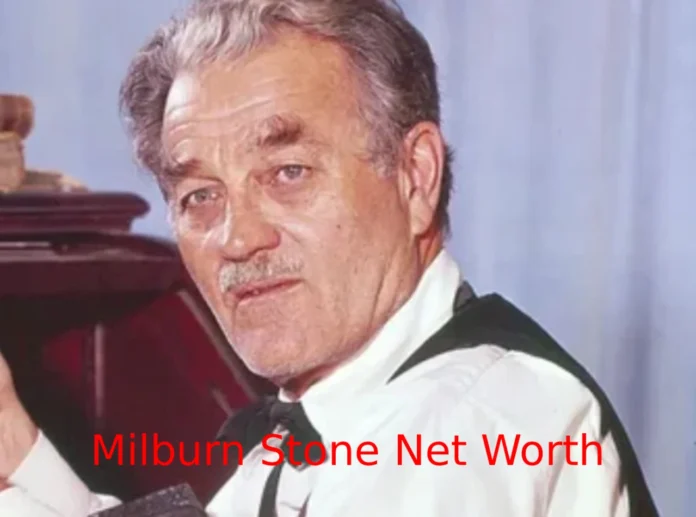
Long before streaming services and multi-million-dollar TV deals became the norm, Milburn Stone quietly built one of the most durable careers in American television history. For twenty years — from 1955 to 1975 — he showed up on CBS as Dr. Galen “Doc” Adams in Gunsmoke, delivering one of the most consistent performances in the history of the medium. Today, fans and historians still search for his story, not just for the nostalgia of a beloved character, but to understand how a Kansas-born actor from the vaudeville era navigated decades of show business and what he had to show for it financially.
Milburn Stone’s estimated net worth at the time of his death in 1980 was approximately $600,000 — a figure that adjusts to roughly $1.8 million in today’s currency when accounting for inflation. It was a respectable fortune for a man of his era and his profession, built not through flashy business ventures or celebrity branding, but through decades of disciplined, consistent craft.
Quick Overview: Milburn Stone’s Net Worth at a Glance
| Detail | Information |
|---|---|
| Full Name | Hugh Milburn Stone |
| Born | July 5, 1904, Burrton, Kansas |
| Died | June 12, 1980, La Jolla, California |
| Known For | Doc Adams, Gunsmoke (1955–1975) |
| Estimated Net Worth at Death | ~$600,000 (≈$1.8M today) |
| Primary Income Source | Gunsmoke CBS salary & syndication |
| Emmy Award | 1968, Outstanding Supporting Actor |
| Total Film Appearances | 168+ |
From Kansas to Hollywood — The Road Less Traveled
Hugh Milburn Stone was born on July 5, 1904, in Burrton, Kansas. He graduated from Burrton High School, where he was active in the drama club, played basketball, and sang in a barbershop quartet. Despite receiving a congressional appointment to the United States Naval Academy, he turned it down, choosing instead to become an actor with a stock theater company.
That decision — choosing the stage over a military commission — set the trajectory of his entire life. Stone spent his early years working with traveling repertory companies and eventually joined a vaudeville song-and-dance act called “Stone and Train.” He later moved to Los Angeles in the 1930s to begin his film acting career, initially being featured in Monogram Pictures’ series of Tailspin Tommy adventures. These were not glamorous assignments, but they gave Stone something more valuable than early fame: range, resilience, and the ability to inhabit a character completely.
In 1939, Stone played Stephen A. Douglas in the film Young Mr. Lincoln. Throughout the 1940s, he continued building a steady filmography — character roles, serials, and supporting parts that never made him a household name but kept him consistently working.
How Milburn Stone Made His Money
Gunsmoke: The Engine of His Wealth
When CBS launched the television adaptation of Gunsmoke in 1955, Milburn Stone landed the role that would define the rest of his professional life. He stayed with the show through its entire television run, appearing in 604 episodes through 1975. That kind of consistency was extraordinary even by the standards of its time, and it translated directly into financial stability.
Stone’s peak Gunsmoke salary reportedly reached approximately $100,000 per season — a figure that, adjusted for inflation, would be equivalent to roughly $900,000 in today’s dollars. His per-episode earnings grew steadily as the show’s ratings climbed. At the peak of his career, Stone is estimated to have earned approximately $5,000 per episode, contributing substantially to his overall net worth.
What made Gunsmoke financially significant wasn’t just the base salary. The show’s success led to syndication deals and residuals that further enhanced Stone’s earnings, providing financial stability both during and after the show’s run. Reruns of Gunsmoke have continued broadcasting for decades, making the show’s syndication value enormous — even if Stone did not fully benefit from it, for reasons explained below.
A Career in Film Before the Small Screen
Stone’s income was never limited to a single source. He made his fortune appearing in 168 movies, including Sky Patrol, Smoke Signal, The Judge, The Long Gray Line, No Man of Her Own, Black Tuesday, and Arrowhead. These film roles, spread across multiple decades, provided a financial foundation long before Gunsmoke made him famous. While none of these parts turned him into a movie star, they kept him working steadily and honed the character-actor instincts that would eventually make Doc Adams one of TV’s most enduring figures.
In 1953, Stone appeared as Charlton Heston’s sidekick in Arrowhead, a Western also featuring Brian Keith and Katy Jurado. Roles alongside major stars like Heston added credibility to his profile and reflected his reputation as a reliable, skilled supporting player.
The $100,000 Residuals Decision
One of the most discussed financial moments in Stone’s career is also one of the more complicated ones. In 1961, Milburn sold his residual rights to Gunsmoke back to CBS for $100,000. In retrospect, given the show’s enduring syndication success, this was a decision he may have reconsidered later in life.
Adjusted for inflation, $100,000 in 1961 is equivalent in purchasing power to well over $900,000 today — and at the time, it would have been a meaningful lump sum for an actor mid-career with no guarantee the show would continue for another fourteen years. It was not necessarily a reckless choice. Residual structures in early television were poorly understood by most actors, and many made similar decisions. Still, it stands as a cautionary footnote in an otherwise well-managed career.
Career Milestones That Shaped His Financial Standing
Stone’s financial arc tracked closely with his critical recognition. The more the industry acknowledged his talent, the stronger his negotiating position became.
The golden moment came in 1968 when Stone won the Emmy Award for Outstanding Performance by an Actor in a Supporting Role in a Drama for his work on Gunsmoke — an achievement that served as industry validation and strengthened his contract standing. A Golden Globe nomination followed in 1971, further cementing his status as a serious dramatic actor rather than simply a western TV fixture.
In 1975, Stone received an honorary doctorate from St. Mary of the Plains College in Dodge City, Kansas, where Gunsmoke was set. That same year, when the show ended, he retired — not under financial pressure, but by choice. His health had already raised concerns. In March 1971, Stone underwent coronary artery bypass surgery and experienced two clinical deaths during the procedure. He survived and returned to Gunsmoke for four more years before the show was finally cancelled.
Milburn Stone’s Lifestyle and Assets
Stone was not a man defined by conspicuous wealth. Across multiple accounts from colleagues and contemporaries, he is consistently described as grounded, private, and relatively modest in his spending habits. Despite significant earnings during his Gunsmoke years, Stone was known for leading a relatively modest lifestyle, focusing on investments and artistic pursuits. He was an accomplished painter who often spent time creating landscape art.
His estate included accumulated savings from four decades of acting work, real estate holdings in Southern California, SAG pension benefits, and ongoing syndication residual rights. Real estate investment was common among successful actors of his era, offering tangible, appreciating assets in a period when the California property market was still accessible at reasonable prices. Stone followed that pattern, supplementing his acting income with property that held and grew in value over time.
After Gunsmoke wrapped in 1975, Stone retired to his ranch — a lifestyle choice that reflected both his Kansas roots and his preference for simplicity over spectacle.
How His Net Worth Compares to His Gunsmoke Co-Stars
Context makes Stone’s financial story clearer. Stone was the only actor besides James Arness to appear through all 20 seasons of Gunsmoke, yet his co-star Dennis Weaver had the highest net worth among the cast at the time of his death in 2006, reportedly $16 million — largely because Weaver left the show early to pursue a broader, more commercially diverse career.
This comparison is telling. Stone’s comparatively modest accumulation was not the result of financial mismanagement so much as a fundamental difference in career strategy. He chose loyalty and craft over diversification. Weaver leveraged early departure from Gunsmoke into a wider range of projects and commercial opportunities. Arness, meanwhile, held a producer’s stake in the show itself — a structural financial advantage that Stone did not share.
Stone’s wealth reflects a man who stayed in one place and built deeply rather than widely.
The Financial Legacy Milburn Stone Left Behind
For his contribution to the television industry, Milburn Stone has a star on the Hollywood Walk of Fame at 6801 Hollywood Boulevard. In 1981, he was inducted posthumously into the Western Performers Hall of Fame at the National Cowboy and Western Heritage Museum in Oklahoma City.
Beyond awards and honors, Stone left a legacy for the performing arts in Cecil County in northeastern Maryland, by way of the Milburn Stone Theatre in North East, Maryland. An institution named in a performer’s honor is, in many ways, a more durable measure of impact than any bank balance.
Stone’s second wife, Jane Garrison, survived him and passed away in 2002, twenty-two years after his death. He was buried at El Camino Memorial Park in Sorrento Valley, San Diego, California.
The financial story of Milburn Stone is ultimately the story of a craftsman. He did not accumulate wealth through business empires or celebrity branding. He did it by showing up — for twenty years on the same show, in the same role, with the same commitment — and managing what he earned with the same quiet practicality he brought to everything else.
Frequently Asked Questions
What was Milburn Stone’s net worth when he died? Milburn Stone had a net worth of approximately $600,000 at the time of his death in 1980. Adjusted for inflation, that figure is roughly equivalent to $1.8 million in today’s purchasing power.
How did Milburn Stone earn most of his money? Stone’s wealth was primarily derived from his extensive work on Gunsmoke, including his CBS contract salary across 605 episodes, as well as film roles in over 168 movies and real estate holdings.
Did Milburn Stone sell his Gunsmoke residuals? Yes. In 1961, Stone sold his residual rights to Gunsmoke to CBS for $100,000 — a significant sum at the time, though one that proved less valuable in hindsight given the show’s decades of continued syndication.
Did Milburn Stone win any major awards? Stone won the Emmy Award for Outstanding Performance by an Actor in a Supporting Role in a Drama in 1968 for his work on Gunsmoke, and received a Golden Globe nomination in 1971.
What did Milburn Stone die of? Stone died of a heart attack on June 12, 1980, in La Jolla, California, at the age of 75 — a continuation of the cardiac vulnerabilities that had plagued him since his bypass surgery in 1971.